Credit: STFC
System-level integration. We integrate science, engineering, and strategy to deliver system-level solutions.
Delivering safe, effective radioactive waste management solutions requires more than individual disciplines. It demands integration across science, engineering, and strategy, with a clear understanding of how complex systems evolve over time.
MCM provides integrated technical leadership across the full lifecycle of radioactive waste disposal – from early-stage strategy and research through to design, safety case development, and implementation – enabling confident decisions and deliverable outcomes at each stage.
We enable our clients to move from uncertainty to confident, deliverable solutions in complex radioactive waste programmes.
MCM provides more than technical advice. We deliver integrated solutions that connect strategy, science, engineering, and safety, enabling confident decisions and successful programme delivery.
Our Team
Our Offering
Our Impact
What sets us apart is integration: tailored for decision-making and solution delivery.
Radioactive waste management is complex, and making the right decision requires a holistic consideration of the challenge at hand.
We bring together geoscience, engineered barrier systems, engineering design, and safety case development to deliver coherent, system-level solutions. Rather than analysis in isolation, we ensure that:
- Design decisions are informed by site understanding.
- Research is aligned with strategic upstream needs.
- Safety cases are underpinned by robust, integrated evidence.
Through our comprehensive, joined-up approach, we enable our clients to progress with confidence, based on a fully integrated system understanding.
Latest News
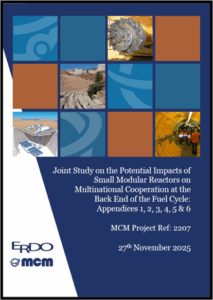
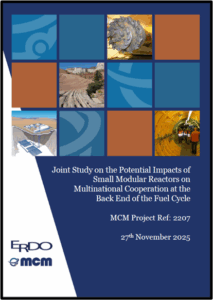
Could a multinational approach to radioactive waste disposal accelerate SMR deployment and facilitate a nuclear renaissance?
In the context of growing enthusiasm for Small Modular Reactor (SMR) commercialisation, MCM and the ERDO Association consider how the widespread adoption of SMRs could stimulate nations to deepen their collaborative efforts in waste management and, vice versa, if multinational efforts to develop disposal solutions could be a catalyst for full scale SMR roll-out.
Our study – available to download below – considers multinational aspects of the potential impacts of SMR commercialisation on the back end of the nuclear fuel cycle, focusing on Spent Nuclear Fuel (SNF). Using credible SMR designs and hypothetical, but representative, countries, the study explores the potential impact of SMR deployment on opportunities for realising multinational RWM and DGR collaboration.

We defined varied MNR models and scenarios to explore the potential impact of SMR deployment on the feasibility of a multinational collaborative approach to SNF disposal and upstream enabling activities, assuming an open fuel cycle.
We conclude that widespread deployment of SMRs is likely in the near-term and that SMR deployment is likely to prompt greater interest in MNR initiatives. We compared a partnered approach to MNR development with a more commercial approach: the former is more likely to involve international SMR technology alignment, requiring strategic engagement prior to SMR deployment; and the latter will likely need to factor the acceptance of multiple SNF types into the MNR design process, introducing technical challenges.
The greater number and geographical distribution of reactors resulting from SMR deployment will introduce new logistical RWM challenges and compound SNF security and safeguards concerns. However, we do not necessarily see these as significant blockers to MNR realisation. The key topics we identify as needing further study are the alignment of upstream activities, the scheduling of waste transports, varied regulatory regimes, and the legal status of importing or exporting radioactive waste for disposal. The most effective next step would seem to be through encouraging SMR vendors to develop relationships with potential MNR providers, e.g., ERDO, and/or with national waste management organisations. This is a two-way process, and organisations such as ERDO should also be promoting discussions with SMR vendors. The overarching issue is that of MNR credibility: SMR vendors are only likely to expend resources on pursuing this approach should concrete MNR commitments surface.
Our published report was developed throughout 2023 and 2024 and brings together two topics which have both seen accelerating developments and increasing attention in this time: both SMRs and MNRs. The publication is a development of that which we had the opportunity to share at the IAEA Spent Fuel Management conference in June 2024 and the 10th IGD-TP Exchange Forum in November 2025.
Click the images below to download.
MCM Launches New Capability Statement: Realigning Around Digital Twin and Digital Ecosystem Integration
MCM is proud to announce the release of our 2025 Digital Ecosystem Capability Statement, marking a significant evolution in how we deliver integrated, future-ready solutions for radioactive waste management and geological disposal.
This new capability statement showcases how MCM has realigned its service offerings around a comprehensive digital ecosystem—an interconnected framework that unites data, models, and safety arguments to inform confident, evidence-based decision-making across the full repository lifecycle.
At the heart of this evolution lies the digital twin: a dynamic, data-driven representation of repository systems that links conceptual, numerical, and safety models with real-world data. Our approach allows continuous validation of long-term performance, enabling transparent decision-making, regulatory confidence, and stakeholder trust.
A New Phase in Digital Maturity
This strategic realignment has been ignited by our adoption of the UK standards, guidance and good practice being promoted by the UK’s National Digital Twin programme, and its wider vision for interoperable, connected digital frameworks across critical national infrastructure.
By adopting these principles, MCM is enabling clients to harness the full potential of their data—transforming complex scientific, engineering, and regulatory challenges into integrated, adaptive digital systems.
Six Integrated Service Areas
Our refreshed structure brings together six core service areas, each contributing to the strength of the overall digital ecosystem:
- Digital Twin & Post-Closure Performance Assessment
- THMC Simulation & Environmental Modelling
- Data Integration & Interoperability
- Advanced Analytics & AI
- Regulatory Digitalisation & Strategic Decision Frameworks
- Concept Development & Engineering Feasibility
These services combine to deliver a seamless pathway from data to decision—connecting cutting-edge science with pragmatic engineering to help clients design, operate, and assure safe, sustainable disposal solutions.
Building Confidence Through Integration
As a UK-based, employee-owned SME located at the Rutherford Appleton Laboratory, MCM continues to work at the forefront of digital transformation in the nuclear sector. Through our growing partnerships and ongoing R&D, we’re committed to advancing the responsible adoption of AI, high-performance computing, and digital safety cases—driving the next generation of repository design, assurance, and regulation.
MCM Achieves Dual ISO Recertification: A Testament to Excellence in Information and Quality Management
MCM Successfully Completes ISO 27001:2022 Transition Audit and Recertifies for ISO 27001 and ISO 9001
MCM has successfully completed the ISO 27001:2022 transition audit in January 2025 and has been recertified for both ISO 27001 (Information Management) and ISO 9001 (Quality Management) in February 2025. This dual recertification demonstrates MCM’s commitment to maintaining the highest standards in both information security and quality management.
Why This Matters
ISO 27001 is the international standard for information security management systems (ISMS), ensuring that organisations manage the security of assets such as financial information, intellectual property, employee details, and information entrusted by third parties. The transition to the 2022 version of the standard highlights MCM’s dedication to staying current with the latest best practices and regulatory requirements.
ISO 9001, on the other hand, is the world’s most recognised quality management standard. Achieving recertification demonstrates MCM’s continuous improvement and commitment to delivering high-quality products and services that meet customer and regulatory requirements.
The Journey to Recertification
The journey to achieving these certifications was rigorous and required a comprehensive review of MCM’s processes and systems. The successful transition to ISO 27001:2022 involved updating policies and procedures to align with the new requirements, conducting thorough internal audits, and ensuring that all employees were trained and aware of their roles in maintaining information security.
Similarly, the ISO 9001 recertification process involved a detailed examination of MCM’s quality management system, ensuring that it continues to meet the stringent requirements of the standard. This included a focus on customer satisfaction, continuous improvement, and the effective implementation of quality management principles.
What This Means for Our Clients
For our clients, this dual recertification is a clear indication of MCM’s dedication to excellence. It assures them that their information is secure and that they can expect consistent, high-quality products and services. Our clients can have confidence in our ability to manage risks, protect their data, and deliver on our promises.
Looking Ahead
As we move forward, MCM remains committed to maintaining these high standards and continuously improving our processes. We will continue to invest in our people, technology, and systems to ensure that we not only meet but exceed the expectations of our clients and stakeholders.
Join Us on Our Journey
We invite you to join us on our journey of excellence. Stay connected with us to learn more about our ongoing efforts to enhance our information security and quality management practices. Follow us on our social media channels and subscribe to our newsletter for the latest updates.